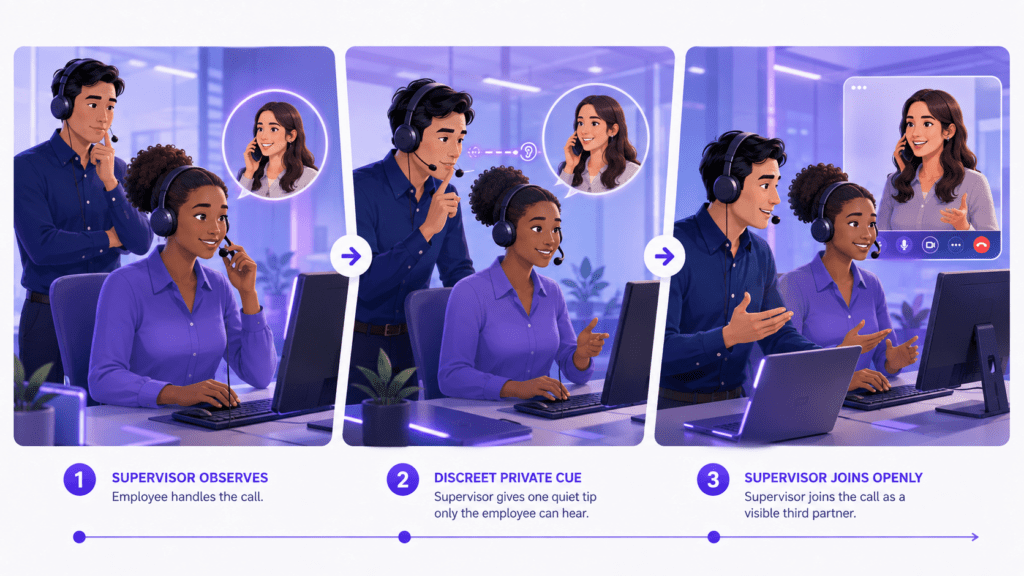
The listen vs whisper vs barge decision determines how directly a supervisor enters an employee’s live call. Listen allows the supervisor to observe without speaking. Whisper provides private guidance to the employee. Barge brings the supervisor into the conversation as an audible participant.
The best coaching usually starts with the least intrusive mode that can solve the problem. Listen to understand what is happening. Whisper when the employee needs a short prompt. Barge only when an immediate, visible intervention is justified. The technology is simple; the judgment, privacy controls, and follow-up coaching matter more.
Important: This article provides operational guidance, not legal advice. Call monitoring, recording, employee notice, and caller consent rules vary by jurisdiction, industry, call type, and employment context. Have qualified counsel review your policy before enabling live monitoring.
Listen vs Whisper vs Barge At a Glance
The three modes differ mainly in who can hear the supervisor and how much ownership the supervisor assumes.
| Mode | Who hears the supervisor? | Best use | Supervisor role | Main risk |
|---|---|---|---|---|
| Listen | Normally neither employee nor caller hears the supervisor, though notifications vary by system and policy | Observation, quality checks, identifying whether help is actually needed | Observer | Secretive or excessive monitoring that damages trust or violates policy |
| Whisper | The employee hears the supervisor; the caller normally does not | A brief factual cue, process reminder, or escalation prompt | Private coach | Distracting the employee or giving conflicting directions |
| Barge | Both employee and caller hear the supervisor | A situation needing immediate authority, correction, de-escalation, or takeover | Visible participant | Undermining the employee or confusing the caller about ownership |
Platform terminology is not perfectly standardized. Some systems use monitor instead of listen, coach instead of whisper, join instead of barge, or offer a separate takeover mode. Microsoft’s supervisor call-monitoring documentation describes monitoring, private consultation, and joining a call as distinct actions. Amazon Connect’s barge documentation similarly separates monitoring from barge permissions. Confirm what each control does in your own configuration before training employees.
Platform terminology is not perfectly standardized. Some systems use monitor instead of listen, coach instead of whisper, join instead of barge, or offer a separate takeover mode. Microsoft’s supervisor call-monitoring documentation describes monitoring, private consultation, and joining a call as distinct actions. Amazon Connect’s barge documentation similarly separates monitoring from barge permissions. Confirm what each control does in your own configuration before training employees.
LISTEN MODE: OBSERVE BEFORE YOU COACH
Listen mode lets a supervisor hear the employee and caller without adding their voice to the conversation. It is useful when the supervisor needs evidence, not assumptions: Is the employee following the process? Is the caller’s request genuinely outside the employee’s authority? Is the problem a knowledge gap, a difficult customer, or a broken workflow?
Microsoft’s current contact-center documentation describes a supervisor monitoring calls without interrupting them and without appearing as a participant. Amazon’s live-monitoring instructions also distinguish a supervisor who listens from one who barges into the call. Cisco’s call-queue configuration guidance shows that an employee notification tone can depend on the platform and configuration.
Good reasons to listen
1. Observe a new employee during an agreed training period.
2. Review how a newly introduced script or policy works in real conversations.
3. Confirm whether an escalation signal is present before intervening.
4. Calibrate supervisors against the same coaching rubric.
5. Spot system or process obstacles that an employee cannot fix alone.
What listen mode should not become
Listening should not become unlimited surveillance, random fault-finding, or a substitute for clear performance expectations. Monitoring every available call simply because the dashboard allows it can create more data than a supervisor can review fairly. Define the purpose, sample, authorized roles, and follow-up process before monitoring begins.
A silent technical mode should not mean a secret management practice. Employees should understand when monitoring can occur, why it is used, who can access calls, how observations affect coaching or evaluation, and how they can raise a concern. This approach follows the Canadian privacy commissioner’s workplace-monitoring guidance.
WHISPER MODE: GIVE ONE USEFUL CUE
Whisper coaching allows the supervisor to speak to the employee without the caller hearing the supervisor. It works best for a short, actionable prompt that helps the employee keep ownership of the call.
Examples include: “Confirm the service address,” “Do not promise that date yet,” “Offer the callback option,” or “Escalate this to billing.” The supervisor should speak in a calm tone, use agreed language, and stop once the employee has the cue.
Whisper is not a second conversation
The employee is already listening to a customer, reading the account, and deciding what to say next. A long whisper creates competing audio and raises the chance of a mistake. If the correction needs an explanation, send a short cue now and save the explanation for the debrief.
Avoid several supervisors whispering into the same call. Assign one coach. The employee should also know how to request help, acknowledge a cue without confusing the caller, and signal when the whisper itself is making the call harder.
Do not confuse coaching whisper with an automated whisper prompt
Some phone systems also use the word whisper for an automated message played before the employee and caller connect, such as the queue name or caller category. Amazon Connect’s whisper-flow documentation describes that separate one-sided pre-connection message. This article concerns live supervisor-to-employee coaching during an active call. Document the distinction so employees know which feature your policy means.
BARGE MODE: JOIN ONLY WHEN THE CALL NEEDS A NEW PARTICIPANT
Barge adds the supervisor to the conversation so the employee and caller can hear them. It changes the social structure of the call, not just the audio. The supervisor is now visible and shares responsibility for the outcome.
Amazon Connect documents barge as a separate permission that a supervisor can enter from a monitored conversation. Microsoft describes Join call as entering the conversation and gaining controls to engage with the employee and customer. Cisco’s current call-queue documentation also distinguishes silent monitoring, coaching, barge, and takeover functions.
Situations that may justify barge
1. The employee asks the supervisor to join.
2. The caller requests someone with authority and the supervisor is the appropriate owner.
3. A material factual error must be corrected before the caller acts on it.
4. The conversation is escalating and a trained supervisor can de-escalate it.
5. A defined safety, fraud, privacy, or policy threshold requires immediate intervention.
These are policy examples, not universal legal thresholds. Regulated, emergency, clinical, financial, and legal-service calls may need specialized escalation procedures and approved personnel.
How to enter without creating more confusion
Identify yourself, explain why you are joining, and make ownership clear. A simple opening is: “Hello, this is Maya, the service supervisor. Alex asked me to join so we can resolve the scheduling issue.” Do not pretend you were present from the beginning if the caller was not told about monitoring.
Decide whether the employee remains the lead, the supervisor takes over, or the call becomes a short three-way conversation. State that decision internally and, when useful, to the caller. After the urgent issue is handled, do not debate employee performance in front of the customer.
USE AN INTERVENTION LADDER, NOT A PANIC BUTTON
A consistent escalation ladder prevents supervisors from barging into every difficult moment and prevents employees from being left alone when risk is rising.
1. Observe. Start in listen mode long enough to understand the request, unless an immediate safety or policy condition requires faster action.
2. Classify. Decide whether the issue is a routine coaching opportunity, a factual gap, an authority problem, an emotional escalation, or a defined high-risk event.
3. Prompt. Use one short whisper if the employee can still own the call with a useful cue.
4. Join. Barge only when the caller needs to hear the supervisor or the employee cannot safely complete the call alone.
5. Clarify ownership. State who will lead the rest of the conversation and what the next step is.
6. Debrief. Review the choice after the call, including what worked and what should change next time.
The ladder is an operational framework created for this article, not an industry standard. Adjust it to your laws, risks, roles, and service model. Document exceptions that allow a supervisor to skip directly to a visible intervention.

THREE ILLUSTRATIVE COACHING SCENARIOS
A new employee handles a quote request
The supervisor listens during an agreed training session. The employee asks the right discovery questions but is about to promise an installation date before checking capacity. The supervisor whispers, “Confirm availability before promising a date.” The employee corrects course and keeps ownership. After the call, the supervisor explains why the cue mattered and updates the coaching note.
A caller disputes an invoice
The employee understands the invoice but lacks authority to approve an adjustment. The supervisor listens long enough to confirm the issue, then whispers, “I can join if they want a manager.” When the caller requests a manager, the supervisor barges, introduces herself, states that the employee has explained the issue, and takes ownership of the adjustment decision.
A caller becomes abusive
The employee follows the company’s warning script, but the behavior continues. The supervisor joins under the company’s approved conduct policy, identifies himself, restates the boundary, and decides whether to continue or end the call. The team documents the incident through the approved process. This example requires a company-specific policy and is not legal advice.
BUILD PRIVACY AND EMPLOYEE TRUST INTO THE PROGRAM
Live coaching should be designed as a limited training and escalation process, not hidden surveillance. The policy must cover the caller, the employee, the supervisor, the audio, any recording, and any notes produced from the session.
Tell employees how monitoring works
The Office of the Privacy Commissioner of Canada’s workplace guidance advises employers to use clear monitoring policies, limit collection to what is necessary, restrict access on a need-to-know basis, and make employees aware of the purpose, nature, extent, reasons, and potential consequences of monitoring. It also recommends reasonable, proportionate, and minimally intrusive practices.
A practical employee policy should name the eligible call types, monitoring purposes, authorized roles, notification behavior, scoring criteria, retention of notes or recordings, access process, complaint route, and consequences for misuse. Train supervisors on the policy before granting permissions.
Handle caller notice and consent deliberately
The Canadian privacy commissioner’s customer-call recording guidance says organizations subject to PIPEDA should inform customers that a call is being recorded, state the purpose, and seek consent, while also limiting use, access, safeguards, and retention. It warns against claiming quality assurance as the purpose if the recording will also be used for an undisclosed purpose.
In the United States, federal interception law includes consent-related provisions, but that is not the end of the analysis. State laws, interstate calls, sector rules, employee rights, collective agreements, and the difference between live monitoring and recording can change the answer. Use a jurisdiction-specific legal review rather than copying a generic “one-party” or “two-party” rule from a blog.
Do not assume that a recording notice automatically authorizes every form of live employee monitoring, transcription, scoring, reuse, or retention. Name each purpose and data flow in the review.
Limit access and leave an audit trail
Grant listen, whisper, and barge permissions by role and team scope. Do not give every administrator access to every call. Keep records of supervisor access and intervention when the system supports it, review those logs, remove access when roles change, and define how suspected misuse is investigated. These controls align with Amazon Connect’s role-specific monitoring permissions and the Canadian privacy commissioner’s need-to-know guidance.
DEBRIEF THE EMPLOYEE AFTER THE CALL
Real-time intervention solves one call. The debrief turns that moment into training.
1. Ask the employee to describe what they noticed and where they felt uncertain.
2. Review the specific behavior, not the employee’s personality.
3. Explain why the supervisor listened, whispered, or barged and whether that level was necessary.
4. Identify one behavior to repeat and one adjustment for the next similar call.
5. Confirm whether a script, knowledge article, permission, or workflow caused the problem.
6. Record only the coaching information the organization has approved and actually needs.
Separate coaching from discipline unless the written policy and facts require a formal process. Employees learn less when every monitored call feels like a search for punishment. They learn more when the rubric is visible, feedback is specific, and supervisors are calibrated.
Live coaching should also feed the system. If several employees need the same whisper, the problem may be a confusing script, missing product information, or insufficient authority. Fix the source rather than coaching the same workaround forever.
MEASURE WHETHER COACHING CHANGES THE NEXT CALL
Do not evaluate the program by counting how often supervisors used each button. More interventions can mean better support, poor training, or intrusive management. Measure the behavior and outcome that justified the intervention.
1. Coaching objective achieved on the employee’s next comparable call.
2. Accuracy of required information and next-step commitments.
3. Correct use of escalation criteria.
4. Calls resolved without an unnecessary supervisor takeover.
5. Repeat whisper topics that point to a training or process gap.
6. Barge reasons, caller outcome, and whether a lower level could have worked.
7. Employee feedback about clarity, distraction, fairness, and usefulness.
Use a shared rubric and review examples across supervisors. A coaching program becomes inconsistent when one supervisor barges at the first objection while another waits through a serious policy error. Calibration helps employees know what to expect.
For recorded-call evaluation, summaries, KPI extraction, and post-call scorecards, use the separate JotLink guide planned for the practical QA workflow and the AI Call Analytics product information. This article stays focused on intervention during the live conversation.
COACH WITH THE LOWEST EFFECTIVE LEVEL OF INTRUSION
Listen to learn what is happening. Whisper when one private cue can keep the employee in control. Barge when the supervisor needs to become an accountable participant. Then debrief so the next comparable call requires less help.
JotLink’s business telephony platform currently documents listen, whisper, and barge controls in its live-call dashboard, along with role-based permissions and call reporting. Before enabling them, define the operational purpose, employee policy, caller notice, permissions, escalation ladder, and legal review that will govern their use.
FREQUENTLY ASKED QUESTIONS
Is live call monitoring the same as call recording?
No. Live monitoring lets an authorized supervisor hear an active call, while recording creates stored audio that can be accessed later. A system may support either or both. Each activity can raise separate notice, consent, access, security, retention, employment, and jurisdictional requirements.
Related sources: AWS live-monitoring guidance and Canadian customer-call recording guidance.
Can the caller hear a supervisor in whisper mode?
In supervisor whisper mode, the employee normally hears the supervisor and the caller does not. Platform behavior, device routing, and configuration can vary, so test the feature before use and train the employee to handle the additional audio.
Related source: JotLink’s documented live call-monitoring modes.
When should a supervisor barge into a call?
Barge when the caller needs to hear the supervisor or when a defined escalation threshold requires immediate participation. Examples may include an employee request, a caller asking for authorized management, a material factual correction, de-escalation, or an approved safety or policy trigger.
Technical references: Microsoft Join call guidance and AWS barge guidance.
Should employees be told that calls can be monitored?
Use a clear written policy and obtain jurisdiction-specific legal advice. As a privacy and trust practice, employees should understand the purpose, nature, extent, authorized users, data handling, evaluation consequences, and complaint process for monitoring, except where a lawful and narrowly defined exception applies.
Related source: Office of the Privacy Commissioner of Canada workplace guidance.
Sources
Microsoft Learn: Monitor calls in the voice channel
Amazon Web Services: Barge into live voice and chat conversations
Amazon Web Services: Listen to live conversations
Amazon Web Services: Set whisper flow
Cisco Webex Help: Configure Call Queue
Office of the Privacy Commissioner of Canada: Privacy in the Workplace
Office of the Privacy Commissioner of Canada: Recording of Customer Telephone Calls