What turns a folder of recorded calls into better employee performance? A call recording QA workflow does, but only when it connects evidence to a clear standard, a specific coaching action, and a later check. Recording a conversation creates material for review. It does not improve the next call by itself.
The practical loop is simple: define what good sounds like, select calls fairly, score observable behavior, calibrate reviewers, coach one or two priorities, and inspect the next comparable conversations. This article shows how to build that loop without turning quality assurance into a hunt for mistakes.
What Should a Call Recording QA Workflow Produce?
A useful QA process produces more than a score. It creates a traceable connection between what happened on a call, what standard applied, what the employee should practice, and whether that behavior changed later.
The ISO overview of ISO 18295-1 describes a customer-contact-center framework that applies across organization sizes, sectors, channels, and inbound or outbound interactions. The standard includes service requirements and performance metrics where required. That broad framing matters: quality should be tied to the service your organization intends to deliver, not to whatever a reviewer happens to notice.
A complete workflow should create six outputs:
- A stated review purpose.
- A recording or transcript selected under a documented rule.
- An evidence-based scorecard.
- A calibrated interpretation of the result.
- A coaching action with an owner and due date.
- A follow-up check on later comparable calls.
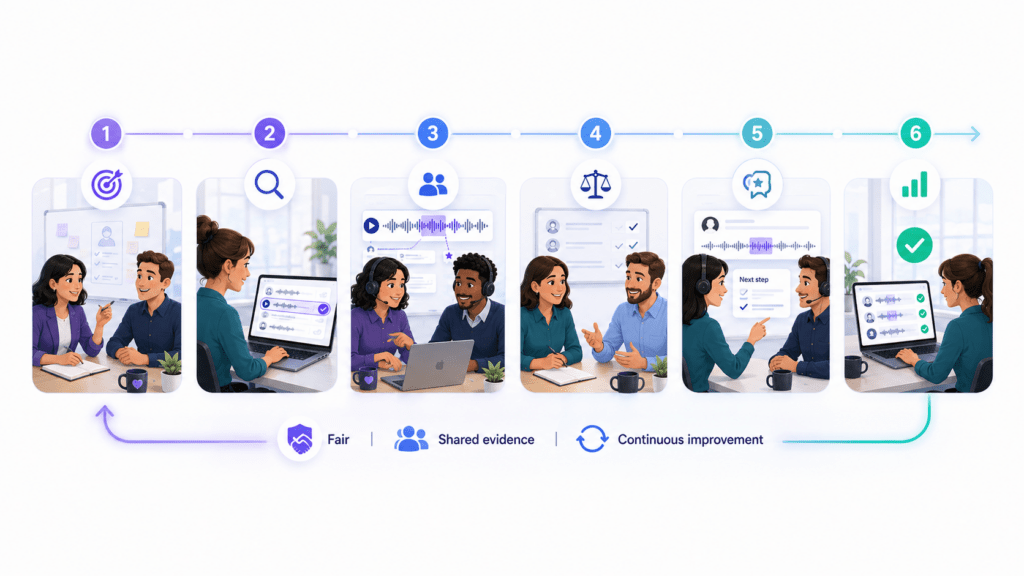
Step 1: Define the Decision Before Reviewing a Call
Start by naming the decision the review should support. “Check quality” is too vague. A reviewer needs to know whether the goal is to confirm a new intake process, diagnose repeat transfers, assess a required disclosure, improve appointment-setting conversations, or coach a new employee.
A narrow purpose improves every later choice. It determines which calls are eligible, which scorecard applies, who can see the result, and what follow-up action makes sense. It also prevents the organization from collecting one type of evidence and quietly reusing it for a different purpose.
For example, a service company introducing a new cancellation policy might define the review purpose this way: “Confirm that employees explain the policy accurately, offer the approved alternatives, and record the customer’s selected next step.” That is observable. “Find out who is bad at difficult calls” is not a fair or useful standard.
Write four lines before the first review:
- Business question: What are we trying to learn or improve?
- Eligible calls: Which queue, call type, date range, or event belongs in scope?
- Decision owner: Who can approve coaching, a process change, or a compliance escalation?
- Evidence boundary: Which recording, transcript, metadata, and notes may the reviewer use?
Step 2: Build a Scorecard Around Observable Evidence
A scorecard should translate the business standard into questions that two trained reviewers can answer from the same evidence. Avoid traits such as “professional personality” or “good attitude.” Score what the employee said, asked, confirmed, documented, or escalated.
Amazon Connect’s evaluation-form documentation shows a practical structure: sections, questions, answer choices, evaluator instructions, optional items, scoring, and weights. It also allows automated answers to be reviewed or overridden by an evaluator. Microsoft’s quality-evaluation documentation similarly separates evaluation criteria, evaluation plans, and resulting scores, summaries, and actions.
Use a small set of meaningful categories
The following scorecard is an illustrative starting point, not a universal standard. Change the categories and weights to match your service, policies, and risks.
| Category | Illustrative priority | Evidence question | Possible coaching use |
|---|---|---|---|
| Accuracy | Highest | Did the employee provide information that matched the approved source? | Practice finding and explaining the correct policy |
| Needs discovery | High | Did the employee confirm the customer’s request, constraints, and desired outcome? | Practice two relevant follow-up questions |
| Ownership | High | Did the employee state the next action, owner, and expected timing? | Practice a clear closing summary |
| Communication | Supporting | Did the employee explain the answer in understandable language and avoid interrupting? | Practice a shorter explanation and confirmation question |
| Required process | Context-dependent | Did the employee complete the approved verification, disclosure, or documentation step? | Refresh the process or escalate a system obstacle |
Define what each answer means
“Met,” “partly met,” and “not met” need evidence anchors. If the question asks whether the employee confirmed the next step, define the required elements. An acceptable answer might require an action, an owner, and a date or trigger. Without anchors, reviewers fill the gaps with personal preference.
Include “not applicable” when a question genuinely does not belong to every call. Do not punish an employee for failing to handle an objection when the caller never raised one. Separate critical process failures from ordinary coaching opportunities, and have qualified owners define any item that can trigger a formal compliance response.
Step 3: Select Calls Without Cherry-Picking
Call selection determines what your QA data can actually tell you. Reviewing only escalations exaggerates failure. Reviewing only short, easy calls hides complex work. Reviewing only calls chosen by a manager invites confirmation bias.
Use a documented mix instead:
- Random selection for a broad view of routine work.
- Event-based selection for complaints, repeat contacts, cancellations, refunds, or missed follow-ups.
- Process-based selection after a script, policy, product, or routing change.
- Journey-based selection that follows one customer issue across more than one contact.
- Development selection for a new employee or a previously agreed coaching objective.
There is no universal number of calls that every small business should review. Call volume, risk, call variety, team size, reviewer capacity, and the decision being made all matter. Record the selection rule with each review so a later reader can distinguish a random sample from a targeted exception review.
Step 4: Score the Call, Then Capture the Evidence
A score without evidence invites arguments. For every meaningful deduction or positive example, record the relevant timestamp, transcript passage, or observable action. The note should explain what happened and which scorecard definition applied.
Compare these two notes:
- Weak note: “Needs better ownership.”
- Useful note: “At 06:42, the employee said someone would call back but did not identify the owner or expected timing. The ownership item requires both.”
The second note gives the employee something concrete to inspect and practice. It also lets another reviewer test whether the score followed the rubric.
Review the full context before treating an isolated phrase as a performance problem. The call may contain a system delay, missing account information, an incorrect knowledge article, or a policy conflict the employee could not resolve. QA should identify process failures as well as individual coaching needs.
Step 5: Calibrate Reviewers Before Trusting the Trend
Calibration asks several reviewers to score the same call independently and then compare their reasoning. The goal is not to force identical opinions. It is to find ambiguous questions, inconsistent evidence standards, and hidden assumptions before those differences affect employees.
Amazon Connect’s calibration guidance describes multiple managers evaluating the same contact with the same form, comparing differences, and refining questions that reviewers interpret inconsistently. It also supports comparison with a designated expert evaluator.
A practical calibration meeting can follow five steps:
- Select one representative call and freeze the scorecard version.
- Have reviewers score independently before discussing the call.
- Compare answers question by question, not only the total score.
- Resolve the definition or evidence rule behind each material difference.
- Document the decision and update evaluator guidance for future calls.
Repeat calibration when the scorecard changes, a new reviewer joins, a recurring dispute appears, or an automated scoring instruction is revised. If reviewers disagree often on one item, fix the item before blaming the reviewers.
Step 6: Turn the Review Into One Coaching Action
A long list of faults is hard to practice. Choose one or two behaviors that matter most to the customer outcome, required process, or employee’s current development goal. Then define what the improved behavior should sound like on the next comparable call.
Consider an illustrative appointment call. The employee answered every question accurately but ended with, “Someone will get back to you.” The scorecard shows weak ownership. The coaching action is not “communicate better.” It is: “Before ending an appointment request, name the next action, identify who owns it, and state when the customer should expect confirmation.”
A short coaching conversation can use this structure:
- Ask the employee what they noticed in the call.
- Review one timestamp and the relevant scorecard definition.
- Explain the customer or process impact.
- Practice the replacement behavior in a brief role-play.
- Agree which upcoming calls will provide follow-up evidence.
Keep the distinction between coaching, process correction, and formal employment action clear. Microsoft explicitly states that its automated quality-evaluation feature is intended to help managers improve service and is not intended for decisions affecting employment rights or compensation. Your organization needs its own reviewed policy, human decision ownership, and applicable legal process.
Step 7: Check the Next Comparable Calls
The workflow closes only when you inspect later evidence. A completed coaching meeting is an activity, not proof of improvement. Review the next calls where the coached behavior could reasonably appear.
Use a small follow-up record:
- Target behavior: What should change?
- Opportunity set: Which later calls gave the employee a fair chance to use it?
- Evidence: What happened at the relevant moment?
- Result: Repeated, partly applied, applied consistently, or not observable yet.
- Next action: Close the item, continue practice, revise the process, or escalate a genuine policy issue.
Do not compare unrelated calls as though they were equivalent. A routine scheduling call and an angry billing dispute demand different behaviors. Look for change within a comparable call type, customer need, and policy context.
Where Should AI Fit Into Call Quality Assurance?
AI can expand coverage and reduce the time spent locating relevant moments. It can transcribe conversations, apply defined instructions, surface possible exceptions, produce structured fields, and prepare coaching suggestions. It should not become the unreviewed owner of policy, context, or high-impact employment decisions.
JotLink AI Call Analytics is documented to analyze recordings using instruction packs and produce summaries, KPI fields, QA scorecards, flags, and coaching recommendations. Outputs can be routed to different stakeholders through Messenger, email, SMS, or an API. Those capabilities support the workflow, but the business still needs to define the rubric, review sensitive exceptions, calibrate interpretations, and decide what action is appropriate.
Microsoft’s quality-evaluation documentation also shows why human review remains important: evaluators can modify responses when an automated interpretation is wrong and regenerate the summary from the finalized evaluation. Amazon’s documentation similarly allows evaluators to override automated answers before submitting an assisted evaluation.
Use automation for coverage and prioritization
- Identify calls that match a defined event or risk rule.
- Draft answers for objective scorecard questions.
- Extract timestamps and transcript evidence for review.
- Group repeated objections, process misses, or follow-up gaps.
- Route different outputs to managers, employees, operations, or compliance owners.
Keep human ownership where context matters
- Approve the scorecard and material changes.
- Review low-confidence, sensitive, or disputed results.
- Decide whether the evidence points to coaching, policy, technology, or staffing.
- Handle formal employment, legal, privacy, and compliance decisions through approved processes.
- Audit whether automated results remain aligned with the current rubric.
How Should You Protect Recordings and Review Data?
A recording may contain names, account details, voice characteristics, payment information, health information, and incidental facts that were never needed for coaching. Limit collection, access, use, sharing, and retention to the approved purpose.
The Office of the Privacy Commissioner of Canada’s call-recording guidance says organizations subject to PIPEDA should inform customers that a call is being recorded, state the purpose, seek consent, use the information only for the specified purpose, apply safeguards, and limit retention. It also warns against announcing “quality assurance” when the recording will actually be used for an undisclosed purpose such as profiling or marketing.
Payment calls need an additional control. The PCI Security Standards Council’s guidance on voice recordings states that sensitive authentication data such as card verification codes must not be stored after authorization, including in digital audio recordings. It recommends preventing the data from being recorded through suppression or redaction where the technology exists.
Before using the call recording controls in a business phone system, document:
- Which calls may be recorded and for which stated purposes.
- How callers and employees receive notice and how required consent is obtained.
- Which roles can play audio, read transcripts, score calls, export data, or see coaching notes.
- How payment and other sensitive segments are suppressed, redacted, or excluded.
- How long each data type is retained and how deletion is verified.
- How employees can question evidence or request correction through the approved process.
What Could a 30-Day QA Pilot Look Like?
This illustrative pilot keeps the scope narrow enough to learn before expanding.
- Week 1: Choose one call type, write the review purpose, confirm legal and privacy controls, and draft a short scorecard.
- Week 2: Test the scorecard on several varied recordings. Run a calibration session and rewrite ambiguous questions.
- Week 3: Complete reviews, provide one specific coaching action per employee, and record which later calls will be checked.
- Week 4: Review comparable follow-up calls, identify repeated process obstacles, and decide what to keep, change, automate, or stop.
Do not judge the pilot only by average score. Review whether questions produced usable evidence, reviewers interpreted them consistently, coaching happened promptly, employees understood the standard, and follow-up calls provided a fair test of the target behavior.
Frequently Asked Questions
How many calls should a small team review?
There is no universal number. Choose coverage based on call volume, risk, call variety, reviewer capacity, and the decision the review must support. Use a documented mix of routine, event-based, and development calls instead of an unexplained number.
Should every recorded call receive a manual score?
No. A team can use automated analysis to broaden coverage and locate relevant calls while reserving human review for calibration, sensitive exceptions, disputes, and coaching decisions. Spot-check automated results against the current rubric.
Can an AI QA score be used as the final employment decision?
An automated score should not be the unreviewed basis for a high-impact employment decision. Keep human ownership, allow evidence to be checked or disputed, and follow qualified legal advice and the organization’s approved employment process.
How long should call recordings and QA notes be kept?
There is no universal retention period. Set periods by documented purpose, applicable law, industry requirements, contracts, dispute needs, and privacy principles. Keep recordings and coaching notes only as long as justified, then verify deletion.
How Do You Make the Next Call Better?
Do not start with a dashboard. Start with one service standard and one call type. Build a scorecard people can interpret, select evidence fairly, calibrate the reviewers, coach a specific behavior, and inspect the next comparable conversations.
If call volume makes manual review impractical, explore how AI Call Analytics can prepare QA scorecards and coaching-ready outputs while your managers retain ownership of the standard, exceptions, and follow-up.
Sources
- ISO 18295-1:2017 customer contact centre requirements overview
- Amazon Connect guidance for creating evaluation forms
- Amazon Connect guidance for performance-evaluation calibration
- Microsoft quality-evaluation documentation
- Office of the Privacy Commissioner of Canada guidance for recording customer telephone calls
- PCI Security Standards Council FAQ on sensitive authentication data in voice recordings
- JotLink AI Call Analytics product information
- JotLink AI Business Phone System product information