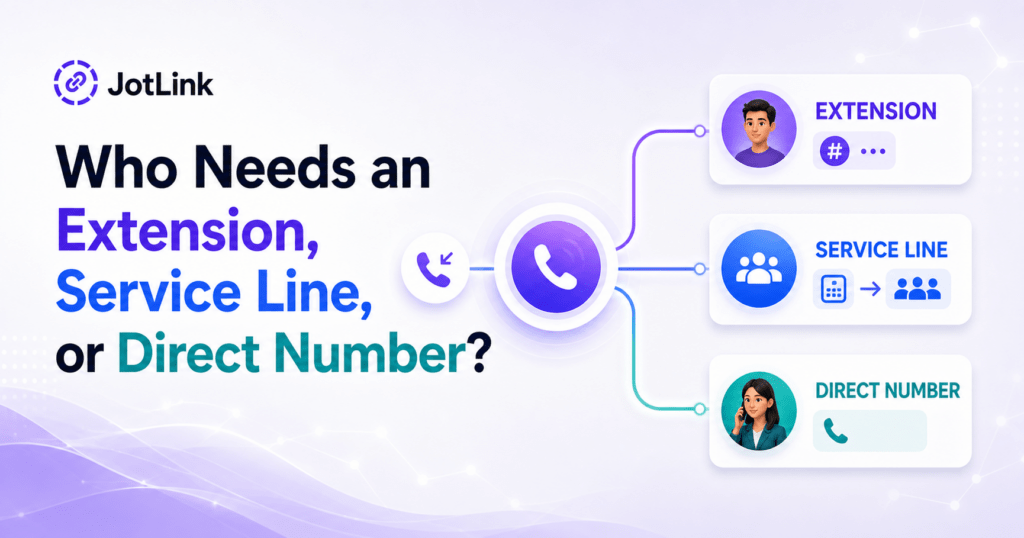
Those three elements are not competing replacements. They solve different jobs. An extension identifies a person or workspace inside the phone system. A service line identifies a business purpose such as sales, scheduling, or support. A direct number lets an outside caller reach one person without starting at the main line.
The right design is usually a combination: stable public numbers for the business, flexible extensions for employees, and a limited number of direct numbers where personal access improves the caller’s experience.
What Is the Quick Answer?
Start with the job the caller is trying to reach, not the phone assigned to an employee.
Use an extension when the employee needs an internal identity, voicemail, transfer destination, or membership in a queue or ring group. Use a service line when customers are trying to reach a function that should survive staffing changes. Use a direct number when callers routinely need one named person and bypassing the front door is intentional.
One employee can use all three. For example, an account manager may have extension 214, answer calls arriving through the shared Client Services line, and have a direct number for an established portfolio of customers. The service line belongs to the function. The extension and direct number are assigned to the person.
Microsoft’s current Teams Phone documentation separates public numbers for users or devices from voice-app service numbers used for call queues and auto attendants. That product uses its own terminology, but the distinction illustrates a broader architecture principle: a number assigned to a person and a number assigned to a service should not be treated as the same object.
What Does Each Option Actually Mean?
Extension
An extension is a short internal identifier, often three or four digits, assigned within the business phone system. Employees can dial it directly, and receptionists, automated attendants, queues, or colleagues can transfer calls to it.
An extension does not automatically need its own public telephone number. It can exist behind the main business number or a department service line. In JotLink, extensions can receive transferred calls, join queues or ring groups, and work through a desk phone or softphone.
Service line
A service line is a public-facing number organized around a purpose, department, location, product, or campaign. Sales, scheduling, billing, emergency maintenance, and customer support are common examples.
The number can route to an IVR, queue, ring group, AI receptionist, extension, or after-hours destination. The important idea is continuity. If an employee changes roles or leaves, the public number remains with the business function.
Direct number
A direct number is a complete public telephone number assigned to one person or, less commonly, one dedicated device. It is often called a direct inward dialing number or DID. An external caller can dial it without choosing a menu option or asking for a transfer.
Public telephone numbers follow national and international numbering plans. The International Telecommunication Union’s E.164 recommendation is the active international public telecommunication numbering standard. An internal extension is not a substitute for an externally reachable E.164 number.
How Do the Three Options Compare?
| Option | Primary identity | Externally dialable by itself | Best for | Continuity when staff changes | Main risk |
|---|---|---|---|---|---|
| Extension | Person or workspace inside the phone system | Usually no | Internal calling, transfers, voicemail, and queue membership | Easy to reassign | Callers may need the main number or a transfer path |
| Service line | Department, purpose, location, or campaign | Yes, when a public number is assigned | Shared customer demand and stable published contact points | Strong because the line belongs to the function | Weak routing or ownership can create a shared inbox nobody owns |
| Direct number | Named employee or dedicated device | Yes | Relationship-based roles and intentional person-to-person access | Requires a documented reassignment plan | Calls can bypass team coverage and follow one employee |
When you compare an extension, service line, or direct number, this is the core distinction: extensions organize people inside the system, service lines organize demand, and direct numbers create public shortcuts to individuals.
Which Roles Usually Need Only an Extension?
An extension is often enough for employees whose calls arrive through a shared business workflow. This includes dispatchers, schedulers, support agents, sales development representatives, back-office staff, and rotating front-desk employees.
They still need a stable internal identity. Colleagues must be able to transfer a call, leave voicemail, or see who handled an interaction. Customers, however, are usually trying to reach the department rather than a specific person.
Consider a repair company with four coordinators. Publishing four personal numbers forces customers to guess who is working and makes coverage fragile. A Scheduling service line can distribute calls to all four coordinators, while extensions let the team transfer a complex case to the right person.
Choose extension-only access when most of these statements are true:
- Calls belong to a shared queue or team outcome.
- Any trained employee can handle the request.
- Coverage matters more than personal continuity.
- The role has frequent shift, territory, or staffing changes.
- External callers do not need to bypass the department workflow.
Which Calls Belong on a Service Line?
A service line is the right public entry point when the caller is asking for a function rather than a person. The name printed on the website should describe what the caller needs: Sales, Bookings, Support, Billing, or Emergency Service.
The service line then controls what happens. During business hours, it might send calls to a queue. After hours, it might play a schedule-specific greeting, offer voicemail, or route urgent requests to an on-call employee. A campaign line can use different reporting and caller ID without changing employee extensions.
Microsoft’s voice-application guidance notes that call queues and auto attendants can have their own associated numbers so outside callers can reach them directly. That implementation is specific to Teams, but it shows why a service identity should be separate from an employee login.
If your service line feeds a queue, ring group, or IVR, decide which distribution method should handle the demand before publishing the number. JotLink’s guide to choosing between a call queue, ring group, and IVR explains the operational differences among those tools.
When Does a Direct Number Make Sense?
A direct number is valuable when the relationship belongs with a named person and the caller should not repeat context at a front door. Account managers, advisors, recruiters, senior salespeople, case owners, executives, and specialized technicians may need one.
Direct access is not automatically better service. It can become a single point of failure if the employee is unavailable. Before assigning a direct number, define unanswered-call behavior, vacation coverage, voicemail ownership, and what happens when the person changes roles.
Use a direct number when most of these statements are true:
- Customers repeatedly ask for the same named person.
- The employee owns an ongoing relationship or case.
- Bypassing the main menu removes unnecessary friction.
- The role has a reliable backup or forwarding rule.
- The company, not the individual, controls the number and call history.
A direct number should still use approved business caller ID. Employees working from personal devices should not need to expose private mobile numbers. JotLink supports extensions, service lines, number assignment, caller ID controls, forwarding, and queue membership within the same phone environment.
Why Do Many Employees Need a Combination?
The best architecture separates how a caller enters from who eventually answers.
A salesperson can have extension 231 for internal transfers, belong to the Sales service line, and receive a direct number only after taking ownership of an account. A field technician can have an extension and answer the Emergency Service line while on call, without publishing a personal direct number. An office manager can answer the main service line and still use a direct number for vendors or building management.
This layered approach protects continuity. Public service numbers remain stable. Extensions can be reassigned as roles change. Direct numbers remain limited to relationships where personal access has a clear benefit.
The JotLink product page describes service lines as dedicated inbound numbers for departments or purposes and extensions as short internal numbers for employees. It also allows a service line to point to an IVR, queue, ring group, or extension. Those capabilities support the layered model rather than forcing one number type on every employee.
How Should You Assign Numbers Role by Role?
Use this short decision process before assigning an extension, service line, or direct number to any role.
1. Identify the caller’s intended destination
Write the request in the caller’s language. “I need to reschedule” is a scheduling function. “I need to speak with Maya about my renewal” is a person-specific relationship.
2. Decide whether the public identity should survive staffing changes
If the answer is yes, use a service line as the published number. Route it to the current team. Do not make one employee’s direct number the permanent contact for a department.
3. Give every phone-enabled employee an internal destination
Assign an extension even when the employee does not receive a direct public number. Use a documented numbering convention that does not expose sensitive information or depend on a person’s hire date.
4. Add direct access only when it improves the workflow
Do not assign direct numbers simply because the provider offers them. Consider demand volume, relationship ownership, backup coverage, and whether the person should be discoverable outside the organization.
5. Define outbound caller ID separately
The number a customer calls and the number an employee displays on outbound calls do not always need to match. A support agent may call from the Support service line so the customer’s callback returns to the covered team. An account manager may use a direct number when personal callbacks are intentional.
6. Design failure paths before launch
Document what happens when the employee is busy, offline, on vacation, or no longer employed. Include timeouts, voicemail, overflow, forwarding, and ownership of follow-up tasks.
7. Record the architecture
Maintain a simple register with the public number, business purpose, internal destination, owner, backup, caller ID policy, porting status, and retirement decision. A diagram is often easier to review than a list of settings.
What Would This Look Like in a Small Business?
Illustrative example 1: home services company
An eight-person home services company has one main line, one Scheduling service line, six employee extensions, and two direct numbers.
The main line answers general questions and routes new customers. Scheduling reaches three coordinators through a queue. Every employee has an extension for transfers. The owner and commercial-project manager have direct numbers because suppliers and existing contract customers regularly need them by name.
The technicians do not publish personal numbers. When one is on call, the Emergency Service route points to that technician’s extension or approved business device. The public emergency number does not change with the schedule.
Illustrative example 2: property management team
A property management company publishes Leasing, Resident Support, and Vendor Access service lines. Leasing agents and support employees have extensions. Each property manager has a direct number for owners and residents with active cases.
If a property manager is away, the direct number forwards to a backup after a defined interval. General maintenance requests still enter through Resident Support, where any available employee can act. The architecture distinguishes an ongoing personal case from shared operational demand.
What Mistakes Make a Number Plan Harder to Manage?
Giving every employee a direct number by default
This creates more public entry points than the business can govern. Calls bypass coverage, caller ID becomes inconsistent, and employee departures require more customer communication.
Publishing one employee’s number as a department line
The person becomes the process. When that person is unavailable, the department appears unavailable too.
Treating an extension as a public number
An extension works only within a compatible routing context. External callers need a public number and a path that recognizes or routes to the extension.
Reusing numbers without a transition plan
Immediately assigning a former employee’s direct number to someone else can expose old voicemail, confuse customers, or send relationship calls to the wrong person. Use a transition period, update greetings, preserve necessary records according to policy, and notify important contacts.
Ignoring outbound identity
If employees call from different numbers each time, customers may not recognize the business or know where to call back. Decide whether each role should show a main line, service line, or direct number.
Forgetting the fallback
Every public route needs an answer for busy, no answer, after hours, holidays, and system interruption. A perfect primary path without a fallback is still an incomplete design.
How Should You Handle Existing and Ported Numbers?
Treat established public numbers as business assets. Before changing providers or reorganizing the phone system, inventory every published number, confirm who controls the account, identify its current destination, and decide whether it should be retained, redirected, or retired.
In the United States, the FCC explains that customers can generally keep an existing number when switching among wireline, IP, and wireless providers while remaining in the same geographic area. In Canada, the CRTC likewise provides guidance on keeping a number when changing providers, subject to service and location conditions.
Portability does not mean every number should be preserved forever. Keep numbers that customers still use, that appear in important listings, or that carry relationship value. Retire duplicates only after a measured transition with forwarding, updated listings, and monitoring.
Frequently Asked Questions
Does every employee need an extension?
Every employee who makes, receives, or may be transferred business calls usually benefits from an extension. Employees with no phone responsibilities may not need one. The extension provides an internal destination without requiring a separate public number.
Can several employees answer the same service line?
Yes. A service line can route to a queue, ring group, IVR, AI receptionist, or another shared workflow. Membership and fallback rules determine who answers and what happens when nobody is available.
Can one employee have both an extension and a direct number?
Yes. The extension supports internal dialing and transfers, while the direct number gives external callers a personal route. The employee may also answer one or more service lines as part of a team.
Should a direct number follow an employee who leaves?
Usually no. A business-controlled number should remain with the company and follow a documented transition plan. Update greetings and routing, protect prior records, notify important contacts, and avoid an immediate reassignment that could confuse callers.
What Should You Assign First?
Before assigning an extension, service line, or direct number, begin with the reasons customers call. Create service lines for those purposes, assign extensions to the people who handle the calls, and add direct numbers only where a named relationship justifies a public shortcut.
If your current setup makes every employee, department, and caller depend on one undifferentiated number, map the call paths before buying more numbers. Explore JotLink’s AI Business Phone System to bring extensions, service lines, queues, ring groups, IVR, caller ID, and forwarding into one structure so the public identity and internal workflow can be designed together.
Sources
- JotLink, AI Business Phone System
- Microsoft Learn, Get telephone numbers in Microsoft Teams
- Microsoft Learn, Manage resource accounts for voice applications
- International Telecommunication Union, Recommendation E.164 (02/2026)
- Federal Communications Commission, number porting guidance
- Canadian Radio-television and Telecommunications Commission, Switch providers and keep your number